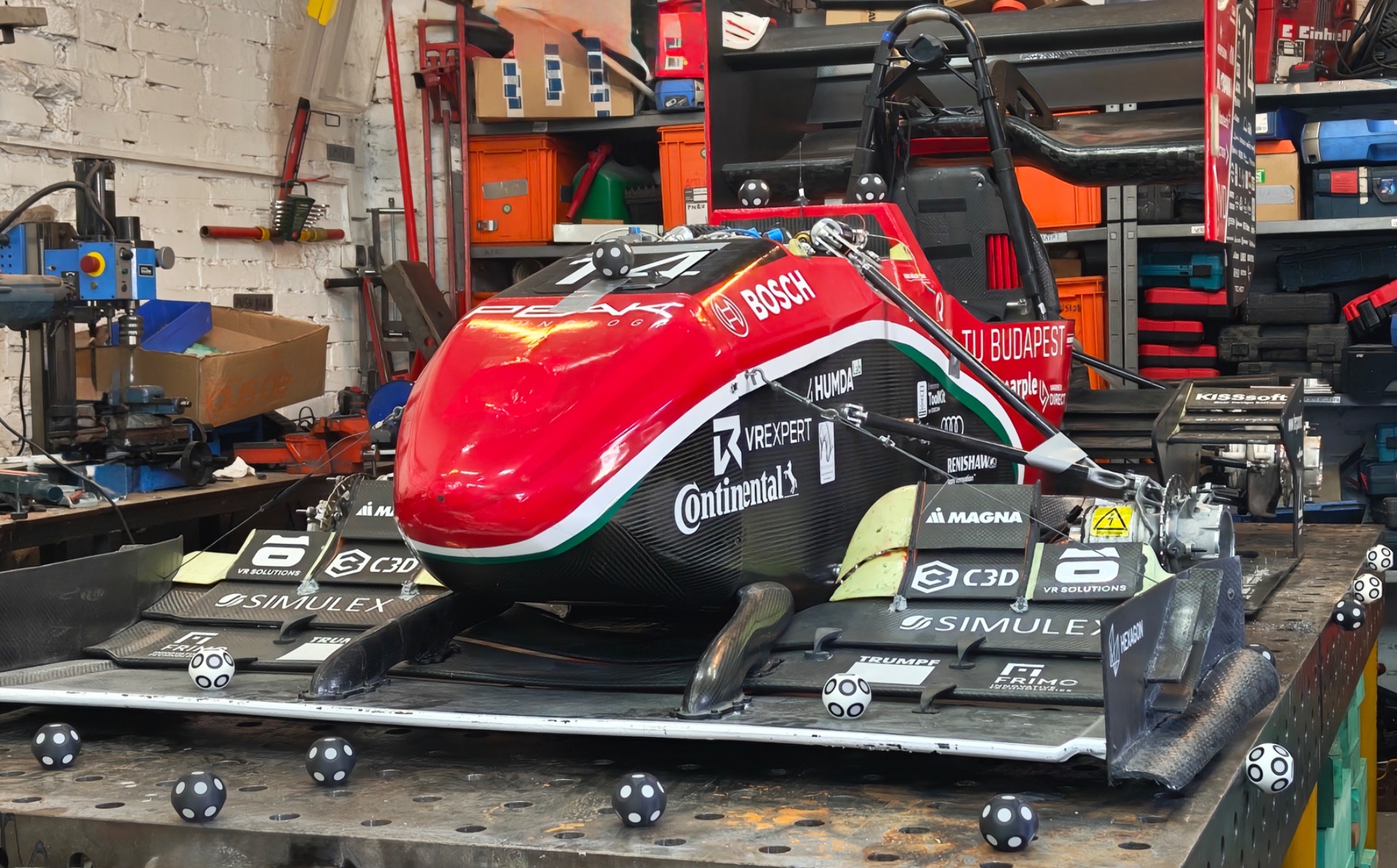
Engineering precision is essential for designing and building a Formula-style race car, as every single millimeter counts. At the BME Formula Racing Team, we have been designing and manufacturing Formula Student race cars since 2007. This competition category is primarily aimed at university students who want to gain competitive, practical knowledge during their studies. Thanks to innovations in the automotive industry and our sponsors’ commitment, we can work with increasingly advanced technologies year after year to achieve the perfect concept.
The Role of the Chassis
For the 2026 season, Werth Magyarország Kft. provided our Chassis group with a Creaform MetraSCAN 3D scanner, ensuring that the manufactured chassis matches our team's vision down to the smallest detail.
The chassis essentially serves as the backbone of the car. Even a single millimeter of deviation can cause anomalies in the vehicle's performance. For this reason, our engineers are constantly seeking solutions that reliably indicate any potential deviations from the blueprint or, where applicable, verify that the digitally designed model matches the finished product perfectly. This is precisely where the Creaform MetraSCAN 3D laser scanner proved to be invaluable to us.
The Scanning Process
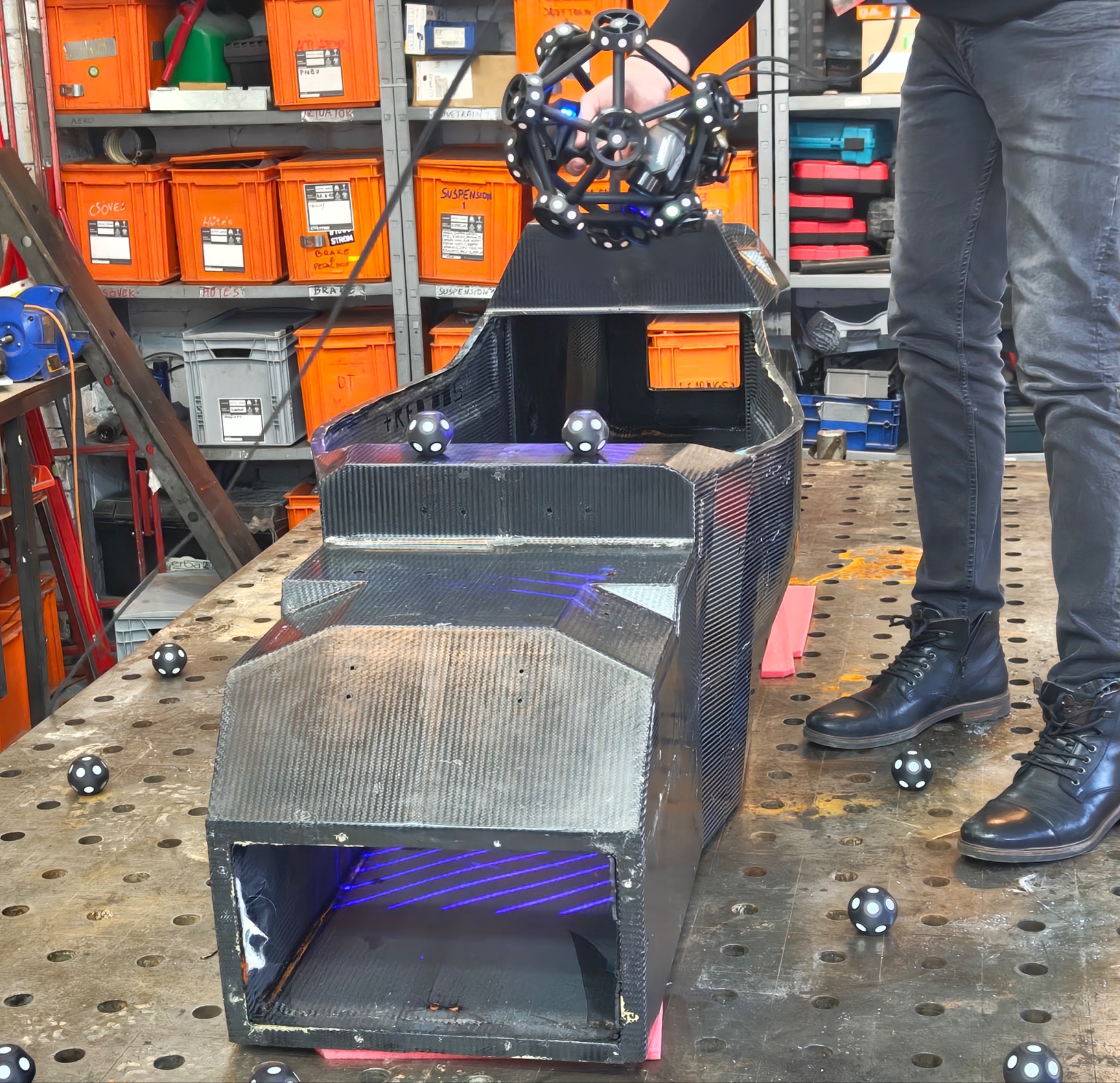
Compared to the smaller devices and manual methods used in previous years, utilizing the Creaform MetraSCAN 3D scanner represented a massive step forward. The carbon composite monocoque we have been working with since 2015 poses a significant challenge for most similar equipment; however, the blue laser technology of the MetraSCAN 3D performed highly effectively, even on this specialized, glossy texture.
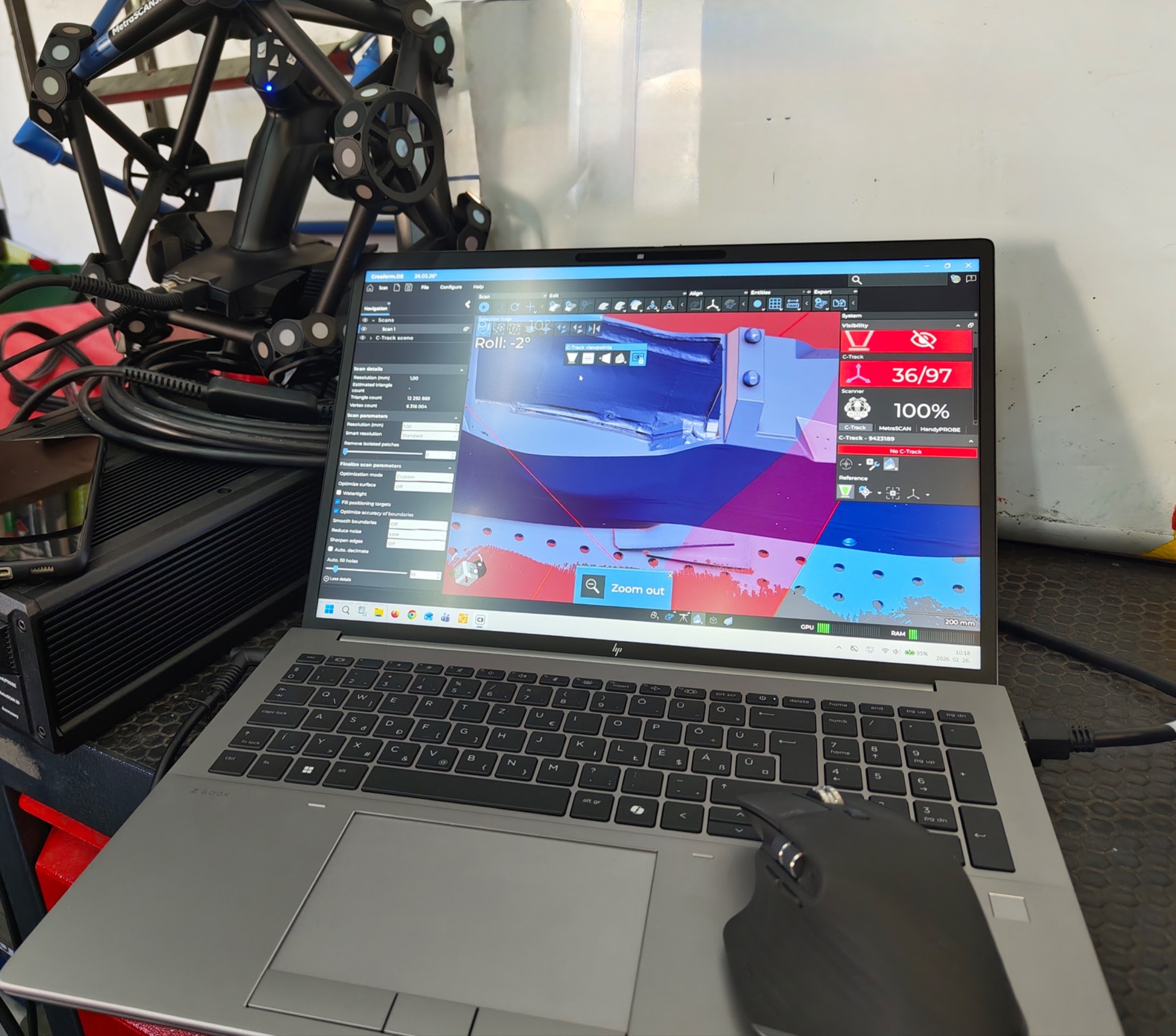
During the measurement process, the instrument projects blue laser lines onto the chassis. The scanner detects the reflections of these lines, determining hundreds of thousands of measurement points per second on the scanned surface. From these points, the system generates a continuous point cloud, allowing us to watch the highly accurate digital twin of the chassis take shape on the monitor in real time. This technology is indispensable for measuring not only the exterior but also the interior surfaces of the chassis, ensuring that every component can be fitted during assembly exactly where it was designed on the CAD model.
Measuring Chassis Stiffnes
One of the most critical elements of the chassis is the suspension mounting points. If these suspension mounting points shift even by a few millimeters compared to their designed positions, it results in unpredictable vehicle dynamics and handling. The 3D scanning of the finished chassis is a highly effective method for visualizing the deviations between the real part and the model, allowing for the correction of any potential positional and/or orientational errors.
However, comparing the actual and planned geometries is only one of the first steps. Once we have verified—by comparing the measurement-based point cloud with the 3D model—that the chassis construction is sufficiently accurate and aligns with the blueprints, the next critical phase is the torsional stiffness measurement. At this stage, we are no longer just examining whether the suspension mounting points are in the right place, but also how the chassis behaves under load, and how much it twists and deforms compared to its original, unloaded state.
During this testing, the chassis is secured at both the front and rear axle lines into a specialized, custom-designed rig. We gradually apply torque to one side of the chassis, performing a full scan at every single load increment. Consequently, this maps out exactly where and to what extent the chassis deforms at each step in response to the different forces.
Performing 3D scanning alongside multi-stage loading serves as a structural validation for us. This measurement allows us to ensure that the structural integrity of the chassis remains stable under the tested conditions, ultimately protecting the driver from any unpredictable physical forces.
Future Outlook and Development
Compared to other solutions we tested, the Creaform MetraSCAN 3D laser scanner generates a much more detailed point cloud, which is crucial in the competitive environment of Formula Student. The advanced measurement and evaluation methods provided by Creaform guarantee that we achieve a highly predictable and reliable design under all conditions. We are incorporating the data and insights gained from these measurements into our design processes. Furthermore, our strategic partnership with Werth Magyarország Kft, along with the technological and expert support they provide, will continue to be indispensable for our team’s ongoing professional advancement.