Behind the Scenes
In the 2025 season, our team set new goals for itself, and even in the first half of the year, we’ve already reached several significant milestones – from team achievements and technical advancements to competition results. In this article, we take you behind the scenes to show the work and people driving these successes.
Season Kickoff
The 2025 season actually began at the end of last summer: team leaders were selected, and the conceptual phase started. Team members began brainstorming across various development directions, which were soon followed by detailed design work.
In the autumn months, several key events gave the team momentum: many talented and motivated students joined, and we successfully participated in the Techtogether+ engineering student competition. In spring, during our Design Freeze event, we presented our full-vehicle concepts, focusing on maximizing points in dynamic events – through weight reduction, intensive testing, and in-house development. The completely reimagined aerodynamic package, the more efficient use of ground-effect, and the improved electronics systems all serve this goal.
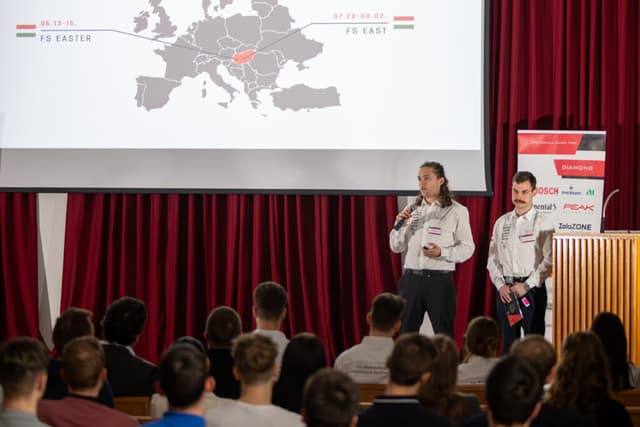
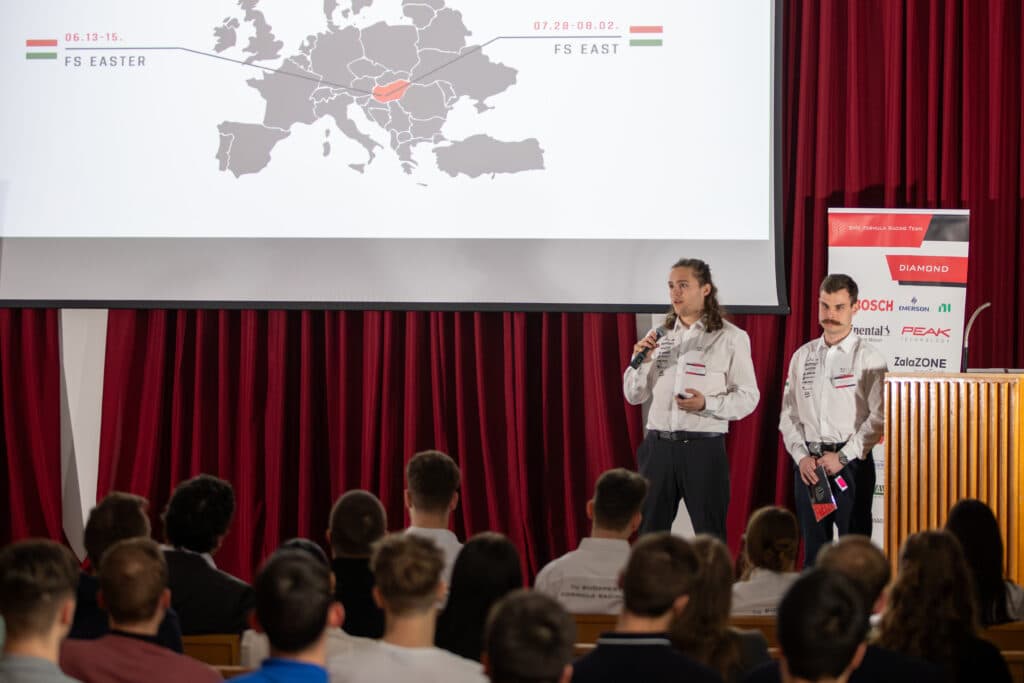
This spring, at the season’s first competition, the Formula Student Easter, we participated without a car – only in the static events – and achieved 6th place overall. Unfortunately, one of the season’s highlights, the FS East event, was canceled this year, so the team faces the summer period in that context.
Although the first half of the year has already been exciting, the main part of the season is yet to come.
Our rollout event is approaching, where we will unveil our 2025 race car. The summer will then conclude with an especially exciting challenge: the Formula Student Germany, one of the most prestigious international competitions. The event offers the opportunity to demonstrate that the concepts we’ve dreamed up, the hard work, creativity, and dedication we’ve invested, truly yield results.
Every season is different – this year even tested our experienced team members. Veteran leaders, group heads, and students who have worked with us for many years unanimously described the past months as “full of challenges.” Introducing new technologies, limited human resources, changing economic conditions, and supplier delays all strained the development schedule.
Still, the shared goal – building a functioning, race-ready car – remained in everyone’s sight. As one team member put it:
“(...) the competition is just the icing on the cake. The fact that we’re building a car from scratch, which we also have to test, is already quite a challenge in itself.”
Inside the 2025 Season
Gergely Szatmári (Electric Powertrain group) described the season in one word: “challenge”:
“We have quite a lot of new developments this season and (...) we may have overcommitted a bit, as the attached diagram also shows.”
Balázs Böröczky (Electronics group) echoed similar thoughts:
“There were many unexpected obstacles to overcome, and a huge amount of work was needed to achieve any success.”
Development and Team Leadership
For Ágoston Demény (Chassis group), introducing the new chassis geometry was already a major burden:
“Creating a new chassis is a big challenge in every aspect, and we really threw ourselves into it at the start of the season. (...) Due to Hungarian manufacturers and the economic situation, making the chassis was even harder, especially machining the prototype – that was clearly the biggest challenge because we also had to find a company and cooperate with them.”
Gergely Szatmári highlighted the challenges of developing a new battery and team building:
“We got several new team members to manage, and putting together a completely new battery from scratch after many years involved a lot of design and production challenges.”
Balázs Böröczky mentioned the difficulty of coordinating the electronics group:
“Coordinating thirteen people so that structured development could happen in the autumn was a pretty big challenge. In the second half of the season, the challenge was to implement the developments we had managed to put together (...) and to parallelize the work so that everyone had space and the necessary tools.”
Motivation, Competitions, Reality
Unexpected events – such as the cancellation of FS East – affected team members in different ways.
Gergely Szatmári commented realistically:
“(...) this was already expected, that there would be no East. It was in the cards. I’m not too upset, there’s a silver lining: we aren’t ready anyway. If East happened, we’d take the car there and spend half the time fixing it.”
Ágoston Demény saw it more negatively from the team perspective:
“It’s quite bad for the team that we’re going to few competitions, especially only to Germany. (...) For an average team member, seeing the car go fast is a big motivator, so missing that can be demotivating.”
Some had mixed feelings but still found the positive side – Balázs Böröczky and Dániel Márton (Aerodynamics group) expressed it this way:
“From a motivation perspective, it was really hard, because it meant that we had to arrive at Germany, our only competition, with a perfect car. In one sense, it gave a boost; in another, it was intimidating.”
“I divide unexpected events into two: internal (we can influence) or external (we cannot). Neither discouraged or demotivated me; I always tried to find alternative solutions to solve problems.”
Expectations for the Rollout
Team members are generally positive about the event, but it means slightly different things to each: a milestone for some, a checkpoint for others.
Balázs Böröczky:
“It’s always a great joy when many people gather to celebrate that the car is ready. And now the rollout is close to the car actually being ready, so it will be a big celebration.”
Ágoston Demény:
“To see that the car we worked on for countless hours throughout the year has come together, and for the sponsors to see it as well.”
Gergely Szatmári:
“(...) I hope for those attending, it will be more than just an ordinary presentation.”
The 2025 season tested the team in every way – technically, logistically, and personally. The many new developments and external factors presented significant challenges. Yet, as the interviews show, the shared goal – to create a working race car – kept the team united. The rollout is not only a milestone but also a celebration – turning plans into reality. Once again, the team proved that at FRT, we build not only machines but also knowledge, community, and the future.